Your packing machine is more than just equipment used to fill bags—it is an important part of your production line that impacts packaging speed, weight accuracy and the overall quality of your product. But do you know that the type of packing machine you select plays a major role in shaping your entire packaging process? Choosing the right packing machine for your product can help you create a faster and more efficient packaging system, which ensures that every bag is packed accurately and consistently.
Whether it’s about selecting a machine for rice, pulses, grains or seeds, or figuring out the right machine for different bag sizes, the smallest details matter. Which packing machine should you choose for your product? That’s the question every manufacturer faces, right? Your curiosity about how product type, packing capacity and bag size influence machine selection will be resolved in this blog, as we will take you through all the essential factors for selecting the right packing machine.
We will also cover important details like weighing accuracy, packaging speed, sealing requirements and level of automation. Let us dive in and understand how to select a packing machine that improves your packaging process, and discover the right solution for your product to achieve accurate weight, faster production and reduced wastage.
Ultimate Guide: How to Select the Right Packing Machine for Your Product
The packing machine is the heart of every packaging line, where products are accurately weighed, filled and prepared for safe delivery. But can selecting the right packing machine significantly impact your production efficiency? The answer is yes. The right machine can help improve packing speed, maintain consistent weight, reduce product wastage and lower dependence on manual labour. However, every product has different characteristics, bag sizes and packaging requirements, so one machine may not be suitable for every application. Whether it is selecting the correct weighing system, determining the required packing capacity or choosing the right sealing method, several factors require careful consideration. In this ultimate guide, discover the best essential factors for selecting the right packing machine for your product and unlock the secret to a faster, more accurate and efficient packaging process.
Benefits of Using the Right Packing Machine
The right packing machine brings accuracy and efficiency, ensuring that everything from product weighing to bag sealing works properly to improve productivity and packaging quality. Here are the key benefits of using the right packing machine:
The choice of the right packing machine according to your product and packaging requirements helps improve the overall speed of the packaging process. A high-speed packing machine can pack up to 1,400 bags per hour, depending on the product and bag size.
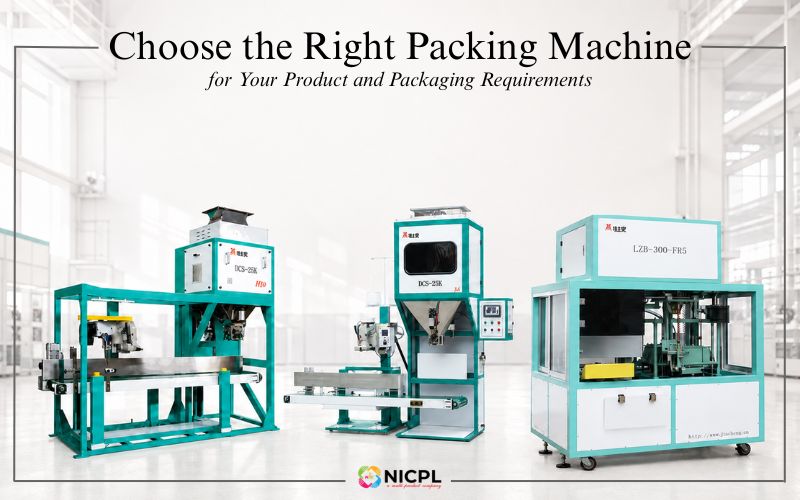
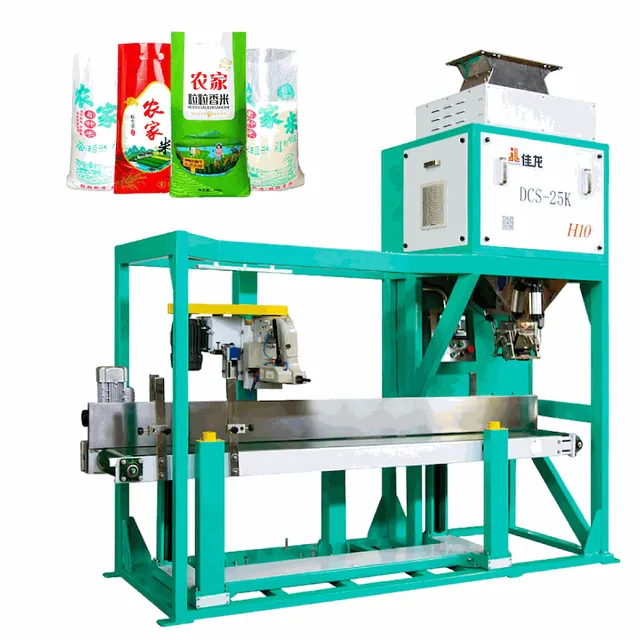
Using the correct packing machine for the required packing range can help ensure accurate weighing and reduce product wastage. For example, the DCS-5S-3A is suitable for packs of up to 5 kg, while the DCS-25K-3A is designed for bags ranging from 5 to 25 kg.
A suitable packing machine helps in reducing manual labour and human errors during the weighing, filling and sealing process.
The right packing machine creates a smooth and consistent packaging process, which provides better weight accuracy, secure sealing and a professional appearance for every bag.
Understand Your Product and Its Packing Behaviour
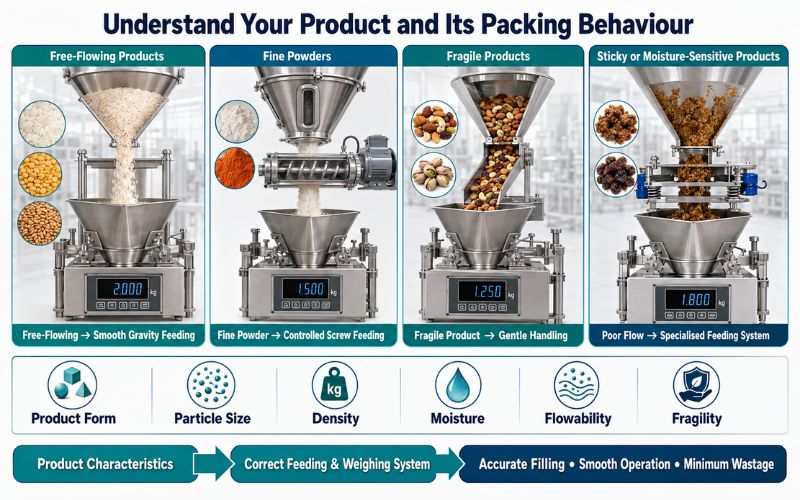
To select the right packing machine, you first need to understand your product and how it behaves during the packing process. Free-flowing products such as rice, pulses and grains move easily through the filling system, while fine powders such as flour and spices may create dust or require controlled feeding. Similarly, fragile, sticky or moisture-sensitive products may need special handling to prevent damage, blockage or inaccurate filling. By checking the product’s form, particle size, density, moisture level and flowability, you can select the right feeding and weighing system. This helps ensure accurate filling, smooth operation and minimum product wastage.
Choose the Right Packaging Format for Your Product
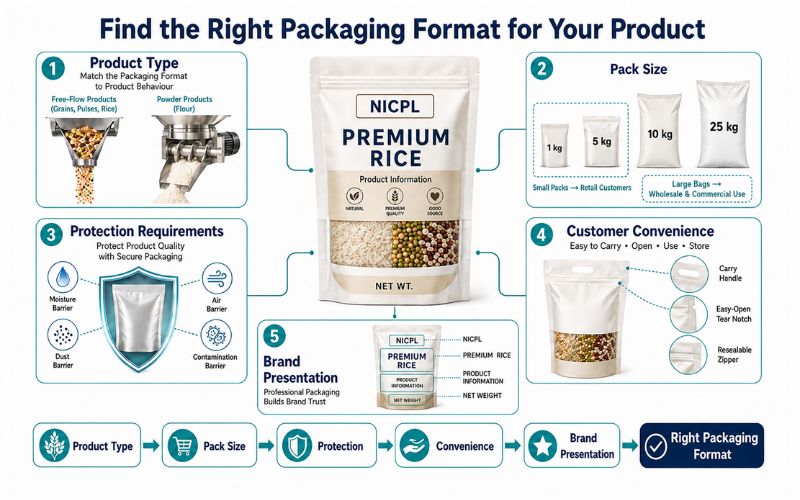
Choosing the right packaging format starts with understanding your product, your production needs and what your customers expect. The right format not only protects the product but also makes it easier to store, transport and use. Here are the most important factors you should consider:
1. Product Type: Every product behaves differently during packing. Rice, pulses and grains flow easily, while flour and other powders may create dust or require controlled filling. Selecting a format according to your product helps ensure smooth and accurate packing.
2. Pack Size: Select a pack size that matches your customers’ requirements. Small packs are suitable for retail customers, while larger bags are ideal for wholesalers and commercial buyers. For example, the DCS-5S-3A is suitable for packs of up to 5 kg, whereas the DCS-25K-3A can handle bags ranging from 5 to 25 kg.
3. Protection Requirements: Think about what could affect your product’s quality. If moisture, air, dust or contamination can damage it, choose a packaging format that provides proper protection and secure sealing.
4. Customer Convenience: Packaging that is easy to carry, open, use and store makes things more convenient for your customers. Features such as handles and resealable closures can improve their experience and encourage repeat purchases.
5. Brand Presentation: Your packaging is often the first thing customers notice. It should represent your brand professionally and provide enough space for your logo, product information, pack weight and other important details.
Select the Correct Packing Range: 5 kg, 25 kg or 50 kg
Every packing range is designed for a specific product, production capacity and customer requirement. Selecting the right range helps improve packing speed, weighing accuracy and operational efficiency. Below is a simple table showing five suitable packing machines for 5 kg, 25 kg and 50 kg packaging, along with their output and best use cases.
Packing Machine Range and Output Chart
Packing Machine
Packing Range
Output (Bags/Hour)
Packing Type
Best Suited For
DCS-5S-3A
0.5 – 10 kg
500 – 900 bags/hr
Heat-sealed retail packs
Rice, Buckwheat, Oats, Barley, Coarse Cereals and Beans,
LZB-600-R10
0.5 – 5 kg
540 – 600 bags/hr
Brick-shaped vacuum packs
Pine Nuts, Cashew, Peanut, Almond, Walnut and Pistachio
DCS-25K-3A
5–25kg 25–50kg
600 – 900 bags/hr 300 – 400 bags/hr
Medium-sized stitched bags
Rice, Beans, Seeds, Sugar, Pulses, Wheat, Maize, Peanut and Dal
DCS-25K-H10
5–25 kg
900–1400 bags/h
High-speed commercial bags
Rice, Grain, Soybean, Peanut, Wheat, Feed, Millet and Corn
DCS-50-A3
5~50KG
300 – 400 bags/hr
Large stitched bags
Rice, Grain, Soybean, Peanut, Wheat, Feed, Millet and Corn
Calculate the Required Packing Speed for Your Production Target
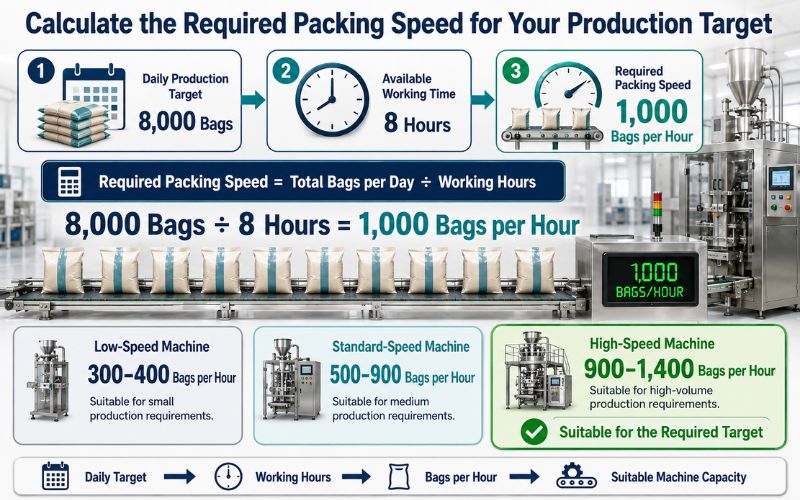
When selecting a packing machine, it is important to calculate the required packing speed according to your daily production target, working hours and total number of bags. Simply divide the total bags required per day by the available working hours to calculate the required output in bags per hour. For example, if your target is 8,000 bags in an 8-hour shift, you will need a machine that can pack at least 1,000 bags per hour. Based on this calculation, you can decide whether your production needs a low-speed machine with an output of 300–400 bags per hour, a standard-speed machine with an output of 500–900 bags per hour or a high-speed machine with an output of 900–1,400 bags per hour. This helps you select the right machine without investing in insufficient or unnecessary capacity.
Check Weighing Accuracy and Product Giveaway
weight accuracy
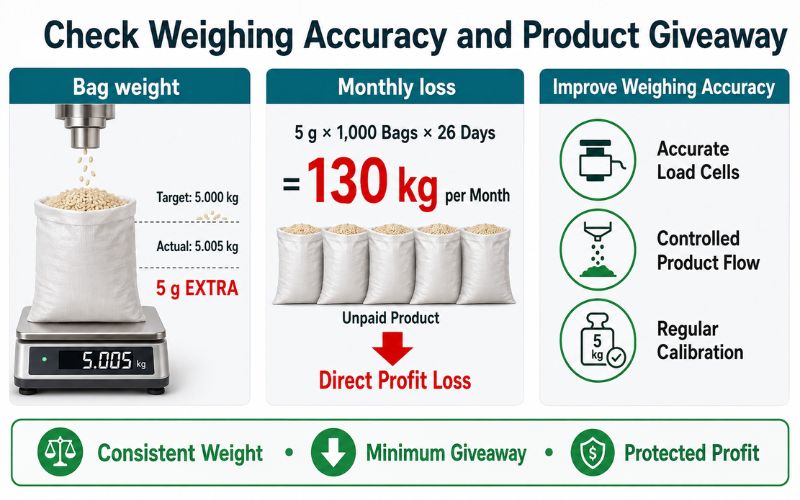
Weighing accuracy is important because even a small amount of extra product in every bag can create a major financial loss at the monthly level, especially when the machine operates at high speed. For example, if each bag contains just 5 grams of extra product and you pack 1,000 bags per day for 26 days, you will give away 130 kg of product every month without charging for it. Accurate load cells measure the correct quantity, while controlled product flow prevents excess material from entering the bag during the final filling stage. Regular machine calibration also ensures that the displayed weight matches the actual pack weight. Together, accurate load cells, stable product flow and proper calibration help reduce product giveaway, maintain consistent bag weight and protect your profit even at higher packing speeds.
Match the Bag Material with the Sealing System
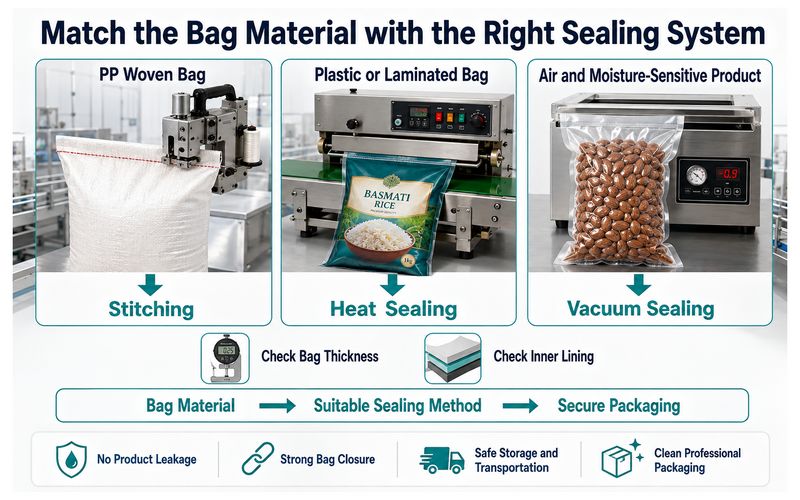
Proper sealing plays an important role in keeping your product safe and preventing leakage during storage and transportation. Matching the bag material with the right sealing system ensures that every bag closes properly and remains strong. PP woven bags are generally closed through stitching, while plastic and laminated bags work better with heat sealing. Products that need protection from air and moisture can be packed using vacuum sealing. Even smaller details like bag thickness and inner lining should be checked carefully to select the correct sealing method. By matching the bag material with a suitable sealing system, you can reduce product leakage, avoid damaged bags and deliver clean, secure and professional packaging to your customers.
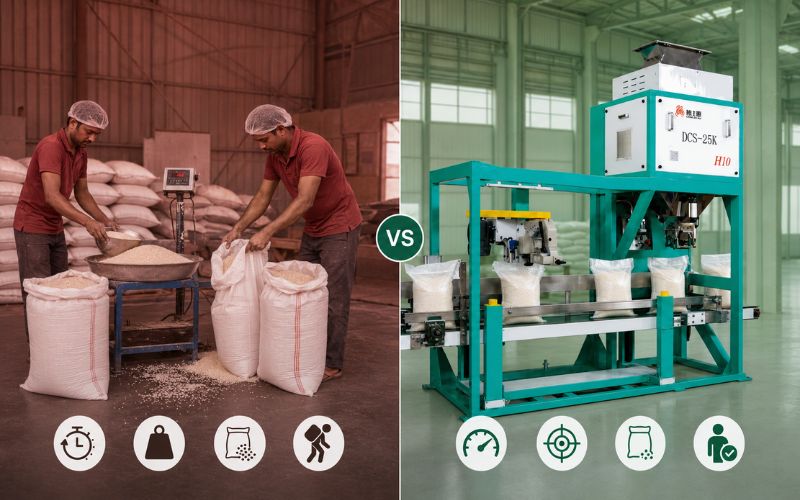
Compare Manual, Semi-Automatic and Fully Automatic Packing
manual packing vs automatic packing
Want to know whether manual, semi-automatic or fully automatic packing is right for your business? Read below to understand how each packing system works based on production speed, labour requirement and business size:
Packing Type
Working Process
Production Speed
Labour Requirement
Ideal For
Manual Packing
Weighing, filling and sealing are handled manually
Low and depends on the operator
High
Start-ups and businesses with limited production
Semi-Automatic Packing
The machine weighs and fills the product, while the operator places and removes the bag
Around 300–900 bags per hour
Medium
Small and medium-sized production units
Fully Automatic Packing
Bag feeding, weighing, filling and sealing are completed automatically
Around 550–1,400 bags per hour
Low
Large factories and high-production units
"The actual packing speed may vary depending on the product, bag size, machine model and operating conditions."
Evaluate Maintenance, Spare Parts and After-Sales Service Support
The availability of maintenance, spare parts and after-sales service plays an important role in keeping your packing machine running smoothly. North India Compressors Pvt. Ltd. (NICPL) provides professional technical assistance, genuine spare parts and dependable after-sales support for packing machines. This helps reduce unexpected breakdowns, control maintenance costs and prevent production delays. For packing machine selection, installation or service support, explore our packing machine solutions or contact NICPL at **+91 70115 54903**.
Packing Machine Selection: Important Do’s and Don’ts
Selecting the right packing machine can improve production speed, weighing accuracy and overall packaging quality. Here are some of the essential do’s and don’ts to follow while selecting a packing machine:
Do’s:
Understand your product type, flow behaviour, density and moisture level before selecting the machine.
Select the correct packing range, such as 5 kg, 25 kg or 50 kg, according to your customers’ requirements.
Calculate the required bags per hour based on your daily production target and available working hours.
Match the bag material with the correct sealing system, such as stitching, heat sealing or vacuum sealing.
Check weighing accuracy, machine output, spare-parts availability and after-sales service before making the final decision.
Don’ts:
Never select a packing machine only because it has the lowest price, as it may not meet your product and production requirements.
Do not choose a machine without testing your actual product and packaging material.
Never ignore maintenance requirements, power consumption, operator training and future production growth while comparing machines.
Summing up!
By considering all the important factors before selecting a packing machine, you can create a faster, more accurate and efficient packaging process that reduces wastage and improves productivity. By now, you may have a complete idea of how product behaviour, packaging format, packing range and required speed influence machine selection. Whether it is checking weighing accuracy, matching the bag material with the sealing system or selecting between manual, semi-automatic and fully automatic machines, these factors will help you choose a reliable and suitable packing solution. Even if your production requirements grow in the future, choosing the right machine capacity and after-sales support can help your packaging line operate smoothly for a longer time.
We hope this guide resolves your doubts about how to select the right packing machine for your product.
To find the right solution for your packaging requirements, explore our range of packing machines at NICPL, where advanced technology meets reliable after-sales support. For more information, contact us at "+91 70115 54903".
We will be back with the next blog soon; till then, stay tuned!
Image Source: NICPL and Google
FAQ:
1. How do I know which packing machine is suitable for my product?
Ans: First, check your product’s type, flow, density, moisture level and pack size. Rice and grains generally flow easily, while flour and powders may require a controlled feeding system. Testing the machine with your actual product before purchase is always helpful.
2. Should I select a 5 kg, 25 kg or 50 kg packing machine?
Ans: Select the range according to the bag sizes you regularly pack. A 5 kg machine is suitable for retail packs, a 25 kg machine works well for commercial packaging and a 50 kg machine is better for bulk supply. Also consider the pack sizes you may need in the future.
3. How can I calculate the required packing speed?
Ans: Divide your daily target by the number of working hours. For example, if you need to pack 8,000 bags in 8 hours, the machine should deliver at least 1,000 bags per hour. Keep some extra capacity for breaks, bag changes and minor stoppages.
4. Why does my packing machine put extra product in some bags?
Ans: Extra weight can occur because of unstable product flow, incorrect machine calibration or problems with the load cells. Regular calibration and proper feeding control help maintain consistent weight and reduce product giveaway.
5. Should I choose a semi-automatic or fully automatic packing machine?
Ans: A semi-automatic machine is suitable when production is moderate and operators are available to handle the bags. A fully automatic machine is better for high production because it can manage bag feeding, filling and sealing with less manual work.